

Yes, you can travel with the lightest mobility scooter. This makes your trip much easier. These scooters fold up. They fit into car trunks. They move easily through airports. Many travelers have problems like lost aids or long waits. But you can handle these with good planning.
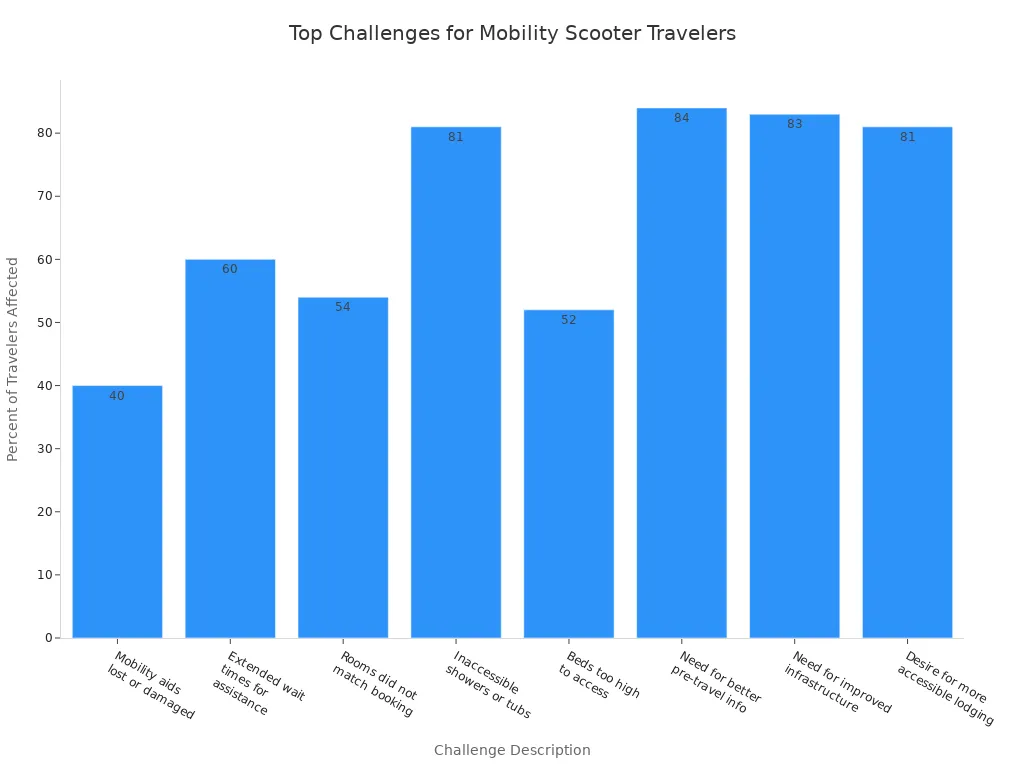
Challenge Area |
Specific Challenge Description |
% Affected |
|---|---|---|
Airport |
Mobility aids lost or damaged by airlines |
|
Airport |
Extended wait times for mobility assistance |
60% |
General Travel |
Need for better pre-travel accessibility info |
84% |
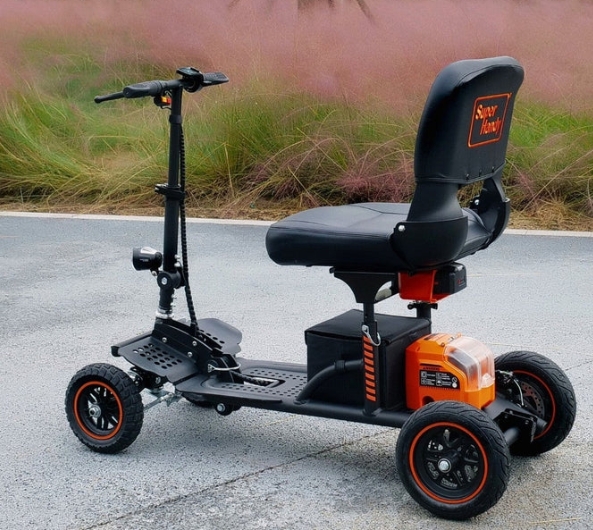
You should feel sure when traveling with a mobility scooter. The right scooter helps you enjoy freedom on every trip.
Key Takeaways
Pick a light, foldable mobility scooter. This will make travel easier. You can be more independent with it. - Plan before your trip. Check airline rules. Get your documents ready. Pack batteries in a safe way. This helps you at the airport. - Use padding and straps to protect your scooter. Learn how to fix problems if they happen. This keeps your scooter safe. Your trip will be less stressful.
Lightest Mobility Scooter Benefits
Why Go Lightweight
Choosing the lightest mobility scooter makes trips easier. You can lift it by yourself. It folds up and fits in a car trunk. You can even store it in a closet at home. Many people say these scooters help them feel free. They can go out alone without needing help. You do not need to worry about lifting something heavy. You also do not have to ask for help every time you move your scooter.
Here’s a quick look at the top benefits:
Benefit |
Explanation |
|---|---|
Enhanced Portability |
Easy to transport, fits in car trunks or public transit, vacation-friendly. |
Indoor and Outdoor Versatility |
Works well in tight indoor spaces and on outdoor paths. |
Enhanced Independence and Freedom |
Lets you travel on your own, without needing a caregiver or taxi. |
You will see a big weight difference between the lightest mobility scooter and regular ones. Some models weigh only 37 pounds. Standard scooters can weigh over 100 pounds. That means you save up to 80 pounds. This makes lifting and storing much easier.

These scooters are small, so you can use them in tight spaces. They work well in small apartments or crowded places. Compact travel scooters fit where big ones cannot.
Superhandy Advantages
Superhandy scooters are special in the world of lightweight mobility scooters. They fold up and roll like a suitcase. This makes it easy to take them on planes, trains, or buses. Superhandy models can hold up to 330 pounds. You do not have to worry about them being weak or breaking.
You get features like tires that do not pop, seats you can adjust, and batteries you can swap. These extras make your ride smoother and more comfy. Many people like the quiet ride and simple controls. They also say Superhandy scooters help them feel free and brave again. If you want a scooter that is light and has lots of features, Superhandy is a great pick.
Preparing for Travel with a Mobility Scooter
Choosing the Right Model
Picking the right scooter makes traveling with a mobility scooter much easier. You want a scooter that folds up fast and fits in small spaces. Look for folding mobility scooters that you can lift without help. Many travelers like models such as the Vive Folding Mobility 4 Wheel Scooter or the Feather 4 Wheel Folding Electric Power Scooter. These scooters fold without tools and use removable lithium-ion batteries. Airlines approve these batteries if they are under 300 watt-hours.
Here are some things to check before you buy:
Make sure the scooter is airline approved and meets FAA rules.
Choose a model that folds or comes apart easily.
Pick a lightweight design for easy lifting and storage.
Check if the battery is removable and meets airline limits.
Look for strong, durable parts that can handle travel.
Think about your needs for indoor or outdoor use, seat comfort, and speed.
Find out if the scooter rolls like a suitcase for easy airport trips.
A good scooter should fit your daily life and your travel plans. You want to feel confident when you go through airports or get in and out of cars. The right scooter lets you enjoy your trip without stress.
Tip: Always check your airline’s website for their list of approved mobility scooters. Some airlines have special forms or extra steps for battery-powered devices.
Essential Pre-Trip Steps
When preparing for travel with a mobility scooter, you need to plan ahead. Airlines have strict rules for batteries and devices. You should start getting ready a few days before your trip.
Follow these steps to make your travel smooth:
Contact your airline at least 48 to 72 hours before your flight. Tell them you are traveling with a mobility scooter. Give them details like the scooter’s weight, size, battery type, and watt-hour rating.
Gather your documents. Bring the user manual, battery label, and proof that your battery is airline approved. Some airlines want you to fill out a Mobility Aid Information form.
Label your scooter with your name, phone number, and where you are going. This helps if your scooter gets lost.
Check your battery. Make sure it is charged and in good shape. If you have a lithium-ion battery, it must be removable and under 300 watt-hours. Pack spare batteries in your carry-on bag, not in checked luggage. Cover the battery terminals with tape or use a battery case to stop short-circuits.
Take clear photos of your scooter before you leave. These photos help if you need to report damage or loss.
Arrive early at the airport. Go straight to the airline counter for check-in and tagging. You may need extra time for security checks.
Attach safe-handling and disassembly instructions to your scooter. This helps airline staff handle your device with care.
Pre-Trip Checklist for Mobility Scooter Travel |
|---|
Contact airline 48-72 hours before flight |
Label scooter with contact info |
Check battery condition and compliance |
Pack spare batteries in carry-on |
Take photos of scooter’s condition |
Arrive early for check-in and security |
Attach handling instructions to scooter |
Note: Most airlines do not charge extra for gate-checking your scooter. If your scooter gets damaged, the airline must repair or replace it.
Traveling with a mobility scooter takes some planning, but you can do it. These tips help you avoid problems and enjoy your trip. When you prepare well, you can focus on the fun parts of travel.
Airline and Transportation Policies
Battery and Weight Rules
When you fly with a mobility scooter, you must follow battery and weight rules. Most airlines let you bring your scooter if the lithium-ion battery is removable and under 300 watt-hours. You have to carry the battery in the cabin, not in checked bags. Airlines like United, Delta, and British Airways want you to take out the battery, cover the terminals with tape, and show the battery’s watt-hour label. Always tell the airline about your scooter and battery before you travel.
Here’s a quick look at what some airlines want:
Airline |
Battery Policy Highlights |
|---|---|
United |
Remove battery, carry in cabin, watt-hour label visible |
Delta |
Removable battery, visual inspection, assistance available |
British Airways |
Remove battery, protect terminals, carry in cabin, advance notice recommended |
Emirates |
Remove battery, max 300Wh or two 160Wh, one spare allowed |
Air Asia |
Battery ≤300Wh or two ≤160Wh, must be in pouch, carried in cabin |
Most airlines do not have a strict weight limit for your scooter. Lightweight scooters around 40-42 pounds are best for flying. Always check your scooter’s size and weight before you go. This helps you avoid problems at the airport. HandyScoot and SmartScoot are good choices because they meet these rules.
Tip: Bring your user manual and battery papers. These help if staff ask about your mobility scooter policy.
Folding and Storage
You want your mobility scooter to arrive safely on the plane. Folding and storing it the right way is important. Practice folding your scooter at home before you leave. At the airport, you can ride your scooter to the gate. The ground crew will put it in the cargo hold and give it back to you when you land.
Follow these steps for folding and storage:
Take out the battery and keep it with you in the cabin.
Fold your scooter and make sure all parts are secure.
Remove baskets or extras and put them in your carry-on.
Label your scooter and battery with your name and contact info.
Give clear instructions to airline staff about how to handle your scooter.
Some scooters are small enough to fit in overhead bins, but most are gate-checked. Airlines do not charge extra for this. If you have questions about flying with your scooter, ask the airline before you travel. Good communication helps you avoid problems and makes your trip easier.
Mobility Scooter Travel Tips for Airports
Security and Check-In
Getting through the airport with your mobility scooter can feel stressful, but you can make it simple with a few smart steps. Arrive early so you have extra time for security checks and airport assistance. Bring your scooter’s user manual, battery info, and any doctor’s note you might need. At the security checkpoint, you may stay on your scooter, but sometimes you’ll need to walk through the scanner if you can. If not, security staff will do a pat-down while you sit.
Here’s what you should do at security:
Remove the lithium-ion battery from your scooter and carry it in a sealed bag in your carry-on.
Show your battery’s label and paperwork to the staff.
Take off any loose accessories and keep them with you.
Let security swab the seat, controls, and battery compartment.
Use padding or a cover to protect your scooter before you check your scooter with baggage.
Tip: Take clear photos of your scooter before you leave home. If you need to report damage, these pictures help a lot.
Gate Check and Boarding
You can ride your mobility scooter all the way to the gate. When you get there, talk to the gate staff about gate-checking your scooter. They will tag it and help you with pre-boarding. Most airlines let pre-boarding passengers use airport assistance to get on the plane first.
Follow these tips for a smooth process:
Fold your scooter and secure it with straps or the parking brake.
Remove the battery and keep it in your carry-on.
Tell the flight crew about your scooter so they know how to store it.
After landing, wait at the gate for your scooter to be returned.
Check your scooter for damage before you leave the airport.
You have the right to take a mobility scooter on a plane. Knowing these mobility scooter travel tips helps you feel ready for boarding and deplaning in a mobility scooter. With good planning, you can enjoy your trip and avoid surprises when you travel with a mobility scooter on a plane.
Other Transportation Modes
Car and Rideshare
There are many ways to move mobility scooters by car or rideshare. If your scooter folds or comes apart, it can fit in most trunks or back seats. Some scooters are too big or heavy for this. You might need special tools or equipment to help.
You can use a rack on the back or top of your car to carry the scooter outside.
A trailer that you pull behind your car works for bigger scooters.
You can put a lift or ramp in your SUV, minivan, or truck to make loading easy.
Pickup trucks can use a hoist to lift and hold the scooter without changing the truck.
Some taxis and rideshare services, like Uber WAV, have ramps or lifts. You can stay in your scooter during the ride. Drivers must help you get in and make sure your scooter is safe. Safety and accessibility are very important when you travel. ADA and DOT rules say drivers cannot say no if your scooter fits their lift and platform. Always check your scooter’s size and weight before you go.
Tip: Always secure your scooter well when you move it. This keeps you and your scooter safe and stops injuries when loading or unloading.
Public Transit and Cruises
Buses, trains, and cruise ships have their own rules for mobility scooters. Most want to make travel easy for everyone, but you should check their rules before you go.
Transit Mode |
Policy Highlights |
Requirements/Restrictions |
|---|---|---|
Buses |
Many allow scooters that meet size and weight limits |
Max length 1200mm, width 700mm, weight 300kg (with user), secure attachment |
Trains |
Most allow scooters with advance notice |
Notify company, book assistance, use designated areas, size limits may apply |
Cruises |
Scooters usually allowed, with accessibility features |
Consider size, disassembly, charging needs, accessible cabins and routes |
Cruise ships have ramps, elevators, and rooms that are easy to use. You can ask for help if you need it to get on or move around. Bus and train workers must help you get on and keep your scooter safe. They focus on safety and making travel easy for everyone. Always tell them early if you need extra help or space for your scooter.
Note: If your scooter blocks aisles or exits, you may not be able to bring it for safety. Always check the size and weight rules before you travel.
Protecting Your Scooter
Preventing Damage
You want your scooter to stay in great shape while you travel. Many things can cause damage, but you can avoid most of them with a few smart steps. The most common problems include battery issues, loose wiring, overheating, stuck wheels, and bumps to the controls or motor. These often happen because of rough handling, vibrations, or carrying too much weight.
Here’s how you can protect your scooter:
Charge your battery fully before you leave. This keeps your scooter ready to use when you arrive.
Use padding, like pillows or foam, to stop scratches and dents during transport.
Strap your scooter down tightly with strong straps. Make sure all parts are locked in place.
Cover your scooter if it rides outside your car or on a rack. This keeps out rain and dust.
Take your time when loading and unloading. Rushing can lead to mistakes and damage.
Tip: Always check your scooter for loose wires or parts before and after each trip. A quick look can save you from bigger problems later.
Handling Issues
Sometimes, things go wrong even when you plan well. If your scooter stops working or gets damaged, stay calm and follow these steps:
Move to a safe spot away from crowds or traffic.
Carry a small repair kit with zip ties, duct tape, and basic tools for quick fixes.
Keep your charger and a plug adapter handy, especially if you travel abroad.
Learn how to spot simple problems, like a dead battery or loose wire.
Have a list of local repair shops or rental services at your destination.
Call your scooter’s support line if you need expert help.
If you fly and your scooter gets damaged, talk to the airline staff and ask for the Complaints Resolution Official.
File a complaint if the airline does not fix the problem.
Note: Always check your scooter’s manual for troubleshooting tips. Knowing your scooter well helps you fix small issues fast.
Essential Accessories and Resources
Must-Have Travel Gear
Bringing the right things helps your trip go well with a lightweight mobility scooter. You want to feel safe, comfy, and ready for anything that happens. Here are some top accessories many travelers like:
Travel Charger: Always pack a charger that works with your scooter’s battery. Pick one that has safety features so it does not overcharge.
Standby Battery: Bring an extra lithium-ion battery for backup. These batteries are light and last a long time, which is great for trips.
Scooter Cover: Use a cover to keep your scooter safe from rain, dust, or sun. This helps your scooter stay nice and work well.
LED Light Kit: Lights help you see better and let others see you when it is dark.
Storage Bag or Basket: Carry things like snacks, water, or your phone easily.
Comfort Seat Cushion: A soft cushion makes long rides much nicer. Memory foam or gel cushions work best for comfort.
Anti-Tip Wheel Attachments: These help your scooter stay steady, especially on rough ground.
Reflective Safety Strips: These strips help people see you at night or in places with little light.
Mobile Phone Holder: Keep your phone close for maps or if you need help.
Weather Shield or Windscreen: Stay dry and comfy if you run into bad weather.
Tip: Make sure each accessory fits your scooter model. Read reviews to find the best ones for comfort and quality.
Where to Get Help
Travel can be tricky, but there is help if you need it. If you have problems with your scooter or need support, try these ideas:
Ask disability groups like Mobility International USA for advice or help.
Call the TSA Cares helpline (855-787-2227) if you need help at airport security.
Contact the Department of Transportation if you have trouble with an airline.
Ask airlines, hotels, or bus and train workers about accessible services before you travel.
Look for airport programs like the Hidden Disabilities Sunflower if you need extra help.
Find repair shops or medical equipment stores at your travel spot.
Keep your scooter’s make, model, and battery info with you.
Know your rights. If your scooter gets damaged, ask for a Complaint Resolution Officer and take pictures.
Check travel sites like Accessible Journeys or Wheel the World for tips on accessible trips.
Note: If you plan ahead and know where to get help, your trip will be easier and more fun.
You can make every trip smoother by following these expert tips:
Protect your scooter with a strong case.
Learn battery rules and pack chargers.
Plan your route and research accessibility.
You have the power to travel confidently and enjoy your independence!
FAQ
Can you take a lightweight mobility scooter on a plane?
Yes, you can! Just make sure your scooter has a removable lithium-ion battery under 300 watt-hours. Always check with your airline before you fly.
How do you protect your scooter from damage during travel?
Wrap your scooter with padding or a cover. Use strong straps to keep it secure. Take photos before your trip for proof if you need it.
What should you do if your scooter stops working while traveling?
Stay calm. Check the battery and wires first. Carry a small repair kit. If you need help, call your scooter’s support line or ask local staff.
