

Many people talk about trailer dolly choices for boats and RVs in reviews. You can see that a trailer dolly helps you move trailers in small spaces. It lets you put your trailer where you want without a tow vehicle. Some good things are a better towing experience, more safety, and better control. But users also talk about problems like the trailer not being steady, slipping on gravel, and needing strength for manual models. Electric movers, like Goodyear Electric Trailer Dolly - 7500lbs and Goodyear Electric Trailer Dolly - 3600LBS, make moving RVs and boats much easier. Trailer Dollies keep getting better for all owners.
Key Takeaways
-
Trailer dollies let you move boats and RVs in small spaces. You do not need a tow vehicle. They give you more control and help keep you safe.
-
Pick a dolly that fits your trailer’s weight. Think about the ground you will use. Use pneumatic tires for gravel or grass.
-
Electric trailer dollies help you move heavy trailers. They make it easier and safer. Watch the battery life. Use safety features like brakes and speed controls.
-
Do regular maintenance like checking tires and charging batteries. This keeps your dolly working well. It also helps it last longer.
-
Learn from other users’ stories. Follow safety tips to stop accidents. This helps you move your trailer more easily.
Trailer Dolly Basics
What Is a Trailer Dolly?
A trailer dolly lets you move trailers without a tow vehicle. You push or steer it using a handle. Most trailer dollies have strong tires and support castors. These help you move trailers on gravel or grass. Some models have two batteries and a strong motor. This gives you steady towing power. You can change the ball attachment and frame to fit many trailers. Safety features like a 7-pin socket for brakes and adjustable ball height help keep things safe and easy.
Tip: Always check how much weight your trailer dolly can pull. Most can move up to 7500 lbs, but you must match it to your trailer’s weight.
-
Main jobs of a trailer dolly:
-
Pull heavy trailers, like RVs and boats.
-
Work on different ground with all-terrain tires.
-
Set up easily with parts you can adjust.
-
Make moving safer and more convenient.
-
Why Use for Boats and RVs?
People use trailer dollies for boats or RVs because parking is easier. You can steer the trailer into small spaces without a tow vehicle. The dolly lifts the trailer tongue and puts weight on its wheels. This gives you better grip and control. Handles act like levers, so you do not need much force. Many people like making small moves in tight driveways or garages. You also lower the chance of getting hurt because you stand up straight.
-
Reasons people like trailer dollies:
-
Easier to move in small spaces.
-
No need for someone to help or a tow vehicle.
-
Better view and control, especially for boats.
-
Less work to keep up than electric models.
-
Fun to use, especially with remote control.
-
A trailer dolly gives you more freedom and safety with your trailer. You can park your RV or boat trailer where you want, even in hard spots.
Best for Boats and RVs

Maneuverability in Tight Spaces
People want trailer dollies for boats and RVs in small places. Many say moving trailers easily is the main reason they pick these tools. You can guide your trailer into a garage or a narrow driveway. You can also move it in a busy storage lot. This lets you park with more accuracy than a tow vehicle.
-
You can turn your trailer around corners or fit it between things.
-
Motorized models help you move heavy boats or RVs with less work.
-
Handles and remote controls make it easier to steer, even in tight spots.
Some people share stories about moving boats into small docks or squeezing RVs next to a house. You can see how being careful in small spaces helps you avoid hitting walls or fences.
Note: Pneumatic or foam tires help you roll over rough ground. This makes moving easier on gravel or grass.
Safety and Control
Safety is very important when moving boats or RVs. You want your trailer to stay steady and not cause accidents. Many people look for features that help with control and safety. Here are some things that help keep you safe:
-
Automatic or powered brakes help you stop fast and safely.
-
Safety brakes keep your trailer from rolling away.
-
Solid or "never flat" tires help your trailer stay steady.
-
Corrosion-resistant finishes keep your dolly strong and safe.
-
Heavy-duty treads and strong frames help with heavy loads and rough ground.
-
Remote controls and speed settings make using the dolly safer and help you make fewer mistakes.
You should always check the tongue weight and make sure it matches your dolly’s limit. If your dolly cannot hold the weight, you might lose control. Experts say keeping the tongue weight safe helps stop trailer sway and accidents.
Tip: Always use safety chains and follow weight rules. Many accidents happen when trailers come loose or sway because of wrong weight.
User-Reported Challenges
You may have some problems when using these tools for boats and RVs. People often say manual models can be hard on your body. Bending to push or steer can hurt your back or cause injuries like tendinitis. Battery life is another problem, especially for drill-powered models.
-
Some people find it hard to move trailers on wet grass or steep hills. Wheels may spin but not move the trailer.
-
Turning dual-axle trailers in tight spots can be hard. You might hear snapping sounds or feel stress on the axles.
-
Surge brakes may not work well, especially on steep hills. Many people like electric brakes better, but these need extra setup.
-
Adding a third wheel to your dolly can help you move better in campgrounds.
Ground type and tongue weight also change how well your dolly works. Pneumatic tires give you about 20% smoother movement on rough ground than solid tires. If your trailer’s tongue weight is too high, you could lose control or break your dolly. Always match your dolly’s limit to your trailer’s needs for best results.
Remember: Picking the right dolly and using it the right way helps you avoid most problems. Listen to other people’s stories and learn from them to stay safe and do well.
Trailer Dolly Electric Movers
Performance on Different Terrains
You want your electric trailer dolly to work on many surfaces. People say these machines do well on pavement and gravel. The wheels roll easily on hard ground. This helps you park in a driveway or on gravel. When you try to park on different ground, grass can be hard. Many people say electric trailer dollies slip on soft grass. The tires spin, and the trailer does not move well. Pneumatic tires help a bit, but grass is still tough for most electric trailer dollies.
|
Terrain Type |
Performance of Electric Trailer Dollies |
Supporting Details |
|---|---|---|
|
Pavement |
Good performance |
Made for flat, hard ground; easy to move and steer |
|
Gravel |
Good performance |
Works well on firm ground; pneumatic tires help with rolling and turning |
|
Grass |
Poor performance |
Not good because tires slip and it is hard to steer |
If you want to park on different ground, pick a dolly with strong tires and good grip. You will get the best results on pavement and gravel.
Battery and Power Features
You need a battery you can trust for your electric trailer dolly. People want batteries that last long and can do big jobs. Lithium-ion batteries are liked because they last longer and charge faster. Many electric trailer dollies show you how much battery is left. This helps you plan and not run out of power. Fast charging is another thing people like. It lets you get back to work quickly.
A strong battery lets you move heavy trailers, even in small spaces. Some models have batteries you can take out and swap. People also like smart brakes. These features make electric trailer dollies safer and easier to use.
User Safety Tips
You should always follow safety tips when using electric trailer dollies. Check the battery before you use it. Make sure the tires are in good shape, especially if you park on different ground. Use the dolly’s brakes when moving heavy trailers. Stay away from the trailer’s path and keep your hands on the controls.
-
Wear gloves to keep your hands safe.
-
Move slowly and do not turn too fast.
-
Look for things on the ground before you start.
-
Use the dolly’s safety features, like brakes and speed controls.
Tip: Always match the dolly’s weight limit to your trailer. This helps stop accidents and keeps you safe.
Many people use electric trailer dollies for better safety and less hard work. You can move heavy trailers with less chance of getting hurt. These machines also help you park with more control and feel more sure of yourself.
Choosing a Trailer Dolly
Weight and Capacity
When you start choosing the right electric trailer dolly, you need to look at weight and capacity first. You should always match the dolly’s tongue weight capacity to your trailer’s tongue weight. Experts say the tongue weight should be about 10-15% of your loaded trailer’s total weight. This balance keeps your trailer steady and safe. If you pick a dolly that is too weak, you risk losing control or damaging your equipment.
Here is a table to help you see which dolly fits your trailer type:
|
Trailer Type |
Recommended Dolly Model |
Tongue Weight Capacity |
Total Weight Capacity |
Additional Criteria |
|---|---|---|---|---|
|
Boats (light trailers) |
Scout 3K |
300 lbs |
3,000 lbs |
Good for small boat trailers |
|
Boats (heavier trailers) |
Carrier 13K |
1,300 lbs |
13,000 lbs |
Handles large boat trailers |
|
RVs and Camping Trailers |
Force 5K, Force 10K |
Up to 900 lbs |
5,000 - 10,000 lbs |
Stablelock tech for extra stability |
|
Fifth Wheel/Gooseneck |
Hitch adapter needed |
Varies |
High capacities |
Must match unique hitch types |
You can also see the differences in weight capacities in this chart:
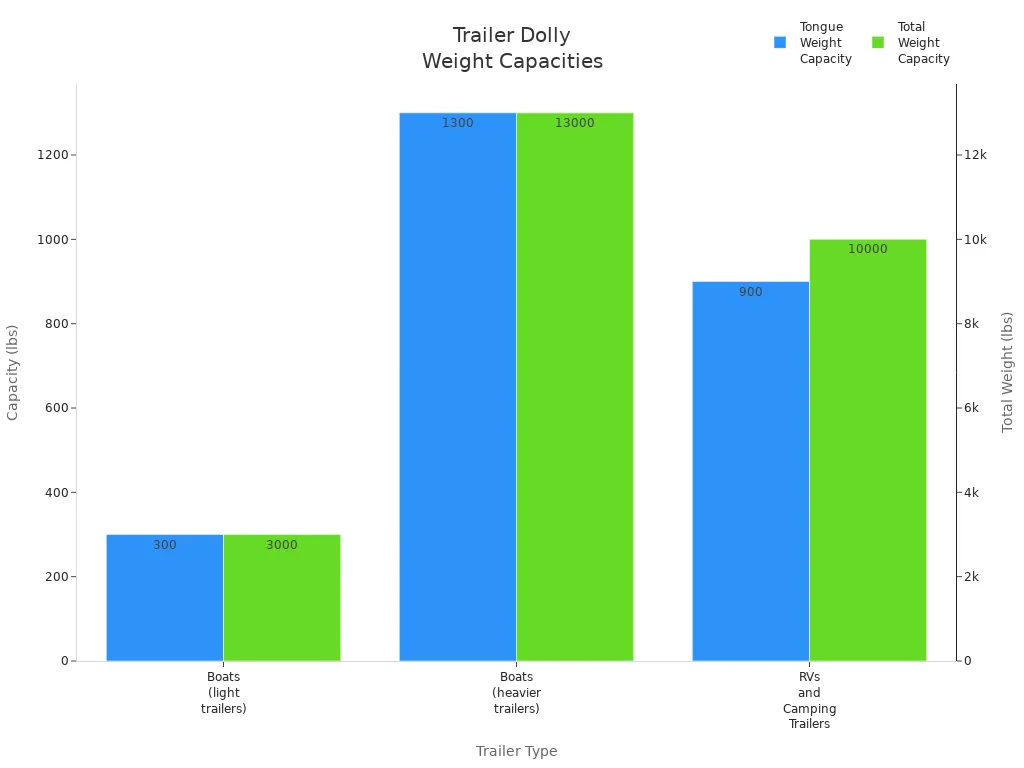
For very heavy trailers, electric powered trailer dollies with hydraulic lifts can move loads up to 40,000 lbs. These models offer attachments for different hitch types, making them flexible for many uses.
Tip: Always check your trailer’s weight before you buy. This step helps you avoid accidents and keeps your equipment in good shape.
Terrain Compatibility
You need to think about where you will use your electric trailer dollies. Terrain changes how well your dolly works. Large wheels give you better grip on gravel or grass. Swivel wheels help you turn in tight spaces but may not work well on rough ground. Steel frames last longer on rocky paths, while aluminum resists rust outdoors.
-
Match the dolly’s rated capacity to your real load, especially on hills or soft ground.
-
Use pneumatic tires for gravel and sand. These tires grip better and make moving easier.
-
Wide caterpillar treads help electric trailer dollies move on grass, dirt, or sand.
-
Keep your load balanced on the dolly for safe movement.
Users say that electric trailer dollies work best on pavement. On loose gravel or sand, you may need to add tongue weight for better traction. Always check the dolly’s size and wheel type for your main parking area.
Brand Comparisons
When choosing the right electric trailer dolly, you should focus on features that match your needs. Look for models with strong motors, long battery life, and easy-to-use controls. Some users prefer remote controls for tight spaces. Others want manual backup options for safety.
You should also think about maintenance. Regular checks on tires, brakes, and batteries keep your dolly working well. Clean the frame and moving parts to prevent rust. Follow maintenance tips for longevity, such as charging batteries after each use and storing your dolly in a dry place.
Note: Good maintenance helps electric trailer dollies last longer and work better. Always follow the user manual for the best results.
If you want to know how to choose the best dolly, start with your trailer’s weight, your main terrain, and your storage needs. For RVs and camping trailers, electric trailer dollies with stable frames and strong tires give you the best mix of power and control.
Real User Stories

Successes with Boats
Many boat owners talk about how electric trailer dollies help them. These tools make it much easier to move boats, even in small spaces. Here are some ways people use them and what works well:
-
You can move your boat trailer exactly where you want, even in busy marinas or tight driveways.
-
Electric trailer dollies mean you do not have to push heavy trailers by hand.
-
The batteries last a long time, so you do not need to stop and charge often.
-
Good brakes help you keep your trailer safe, even on small hills.
-
You can change the height and use the dolly with many kinds of trailers.
-
Taking care of your dolly helps it last longer and work better.
-
Using boards or supports can help you keep control on bumpy ground.
Many people say they feel safe and happy using electric trailer dollies for their boats. You save time and energy, so you can enjoy your day on the water more.
RV Maneuvering Experiences
Using electric trailer dollies for RVs can be hard sometimes. Small spaces, heavy trailers, and rough ground make moving tricky. Some people say backing up RVs into small places is tough. You might see marks on your driveway from the weight. Electric trailer dollies work best on flat ground. On hills or soft dirt, you may need to put plywood under the wheels. Friends can help guide you around things like tree branches. You can use bricks or markers to help you stop in the right spot. Picking the right dolly size and type keeps you safe and in control. Many people like front hitches because they make pushing and pulling easier, but they add weight to the front of your vehicle.
Lessons Learned
People who use electric trailer dollies for a long time have good tips. They share both good and bad things about using them for boats and RVs:
-
Flat, hard ground is best for easy control of your trailer.
-
Tires with air help stop the dolly from sinking into soft ground.
-
Checking tires and batteries often keeps your dolly working well.
-
Moving heavy trailers can be hard and sometimes you need help, especially on hills.
-
Electric trailer dollies do not work for every job. How well they work depends on the ground, trailer weight, and your own strength.
-
Some people use other tools, like a riding mower or car jack, for certain jobs.
Remember, to have a good towing experience, pick the right dolly, take care of it, and listen to advice from others. Your success comes from matching your dolly to your needs and knowing what it can and cannot do.
You have seen how trailer dollies help you move boats and RVs with less effort. User stories show that you get better control and safety when you pick the right dolly for your needs. Think about your trailer’s weight, the ground you use, and your storage space.
Learn from real experiences and stay updated on new features. This helps you make smart choices and enjoy easier trailer moving.
FAQ
How do you know which trailer dolly fits your boat or RV?
You should check your trailer’s tongue weight and total weight. Match these numbers to the dolly’s capacity. Look for features that help with your main terrain, such as pneumatic tires for gravel or grass.
Can you use a trailer dolly on hills or uneven ground?
You can use a trailer dolly on small hills or uneven ground. You should move slowly and watch for slipping. Use safety brakes and add boards for extra grip if needed.
What maintenance does a trailer dolly need?
You should check tires for air and wear. Charge batteries after each use. Clean the frame and moving parts. Store your dolly in a dry place to prevent rust.
Is it safe to move heavy trailers alone with a dolly?
You can move heavy trailers alone if you follow safety tips. Always check the weight limit. Use brakes and move slowly. Ask for help if you feel unsure.
How long does a battery last on an electric trailer dolly?
Most batteries last for several hours or up to 30 miles. You should check the battery level before each use. Fast charging helps you get back to work quickly.
